
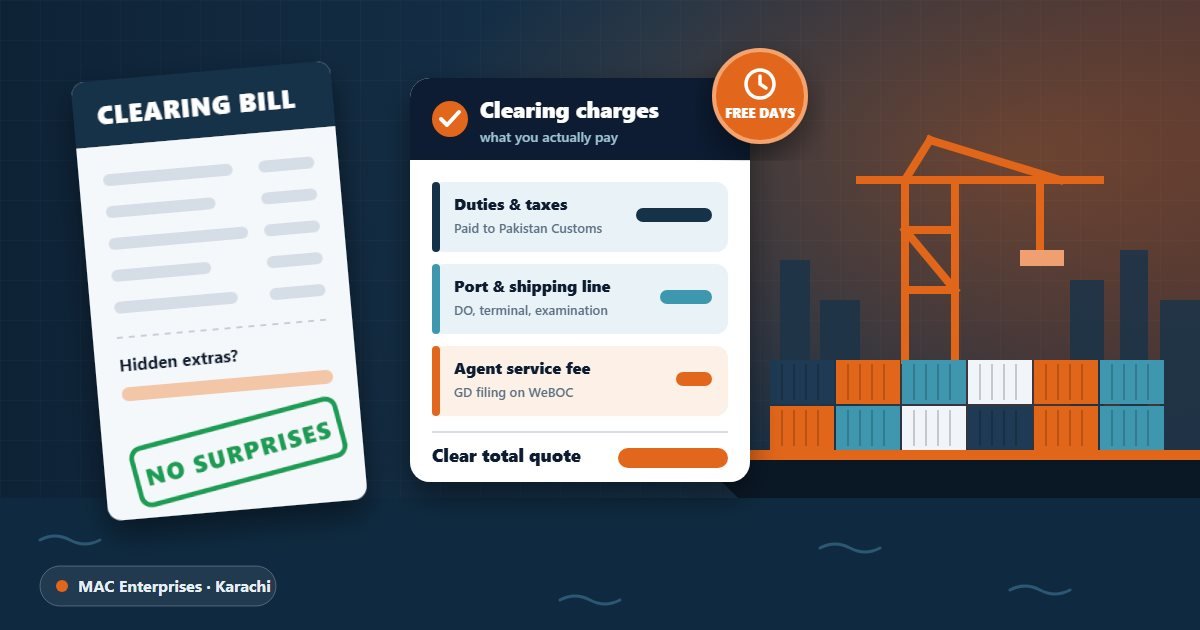
The first question most importers ask a clearing agent in Karachi is simple: "How much will clearance cost?" The honest answer is that the final bill has three separate parts, and only one of them is the agent's fee. Importers who understand the three parts can compare quotes fairly and avoid the surprise costs that appear after the cargo reaches the port. This guide explains what you pay for, who you pay, and how to keep the total under control.
1. Government duties and taxes (not the agent's income)
These are paid to Pakistan Customs through the Goods Declaration (GD) filed on WeBOC. Depending on the PCT heading and the notifications in force, they can include customs duty, additional customs duty, regulatory duty, sales tax and advance income tax. This is usually the largest part of the bill, and it depends on the assessed value and the correct classification of the goods, not on who clears them. Rates change with the Finance Act and SROs, so ask for a breakdown instead of one total. You can read how an estimate is prepared in our guide to a duty estimate before shipping to Pakistan.
2. Port, terminal and shipping line charges
These are paid for services that the cargo uses between the vessel and the gate. Typical items are:
- Shipping line charges: delivery order (DO) and related documentation charges.
- Terminal or port charges: handling, storage after the free days, and gate-out.
- Examination and labour: opening, inspection and re-stuffing if customs selects the consignment for examination.
- Demurrage and detention: the shipping line charges for keeping containers beyond the free time, which are the most avoidable cost on the bill.
- Transport: trucking from Karachi Port, Port Qasim or a dry port to your warehouse.
Free days are short, so delays in documents or approvals turn directly into money. Read our guide on demurrage and storage avoidance at Karachi Port and Port Qasim for practical steps.
3. The clearing agent's service fee
This is the fee for filing the GD, classification, assessment, follow-up with customs, examination supervision and coordination of the gate-out. A licensed agent should state this fee clearly and separately. When one quote is far lower than the others, check what is missing from it before you accept: some quotes leave out port or examination costs and add them later.
What makes the total bill go up
- Wrong or vague goods description on the invoice, which leads to a wrong PCT heading and a higher assessment.
- Mismatch between invoice, packing list and bill of lading, which can trigger a valuation query.
- Missing NOCs or approvals (for example DRAP, PSQCA, ANF or Plant Protection, depending on the goods), which keep the cargo at the port while charges run.
- Late filing of the GD after the vessel arrives.
- Selected for examination without the paperwork ready to answer queries on the spot.
How to compare quotes properly
- Ask for the estimate in three blocks: government duties and taxes, port and shipping line charges, and the agent's fee.
- Confirm the Incoterm (FOB, CFR, CIF or DDP), because it decides which costs are already paid abroad. See our note on DDP shipping from Turkey and Dubai to Pakistan.
- Ask for the expected timeline, including examination and any NOC approvals, not only the price.
- Confirm that the agent is licensed and files on WeBOC or PSW under their own license.
- Ask what is not included, and who pays if demurrage starts because of a delay on either side.
How to keep the cost down
Send the commercial invoice, packing list and bill of lading to your agent before the vessel sails, not after it arrives. Ask about NOC requirements for your product early. Prepare transport in advance so that the container leaves the terminal inside the free days. Importers who do these three things rarely pay demurrage. For a first-time import, start with our step-by-step custom clearing in Karachi guide.
Get a clear quote from MAC Enterprises
Send your invoice, packing list and bill of lading on WhatsApp at 0344 5138903. We reply with a quote that separates government duties, port charges and our fee, plus a clearance timeline, at no charge. We clear at Karachi Port, Port Qasim, KICT, QICT and SAPT and at all dry ports. See all customs clearance and freight forwarding services, the cargo categories we handle, or contact our Karachi office.
Note: duty rates, taxes and port tariffs change often. Always confirm the figures that apply on the date your GD is filed.