
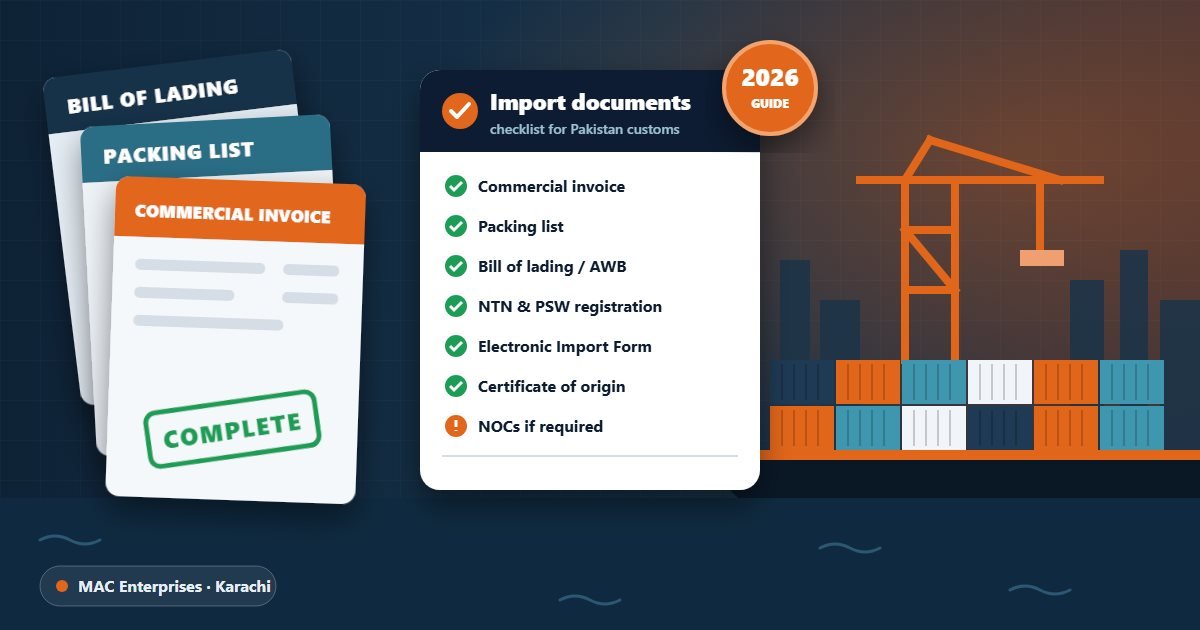
Most clearance delays at Karachi Port and Port Qasim start with a missing or mismatched document. A Goods Declaration (GD) can only be filed and assessed when the paperwork is complete and every document tells the same story about the goods. This checklist covers the documents a commercial importer in Pakistan should have ready, grouped in the order they are usually needed. Use it before your supplier ships, not after the vessel arrives.
1. Registrations you need before the first import
- NTN (National Tax Number): commercial imports are filed against the importer's NTN.
- Sales tax registration (STRN): needed by most commercial and industrial importers.
- Pakistan Single Window (PSW) / WeBOC profile: the importer's profile is used to file the GD and to link the licensed customs agent who files on your behalf.
- Bank account with an authorised dealer: needed for the Electronic Import Form and for paying the supplier.
These are one-time steps, but they take time. If you are a first-time importer, complete them before you place the order.
2. Commercial documents from your supplier
- Commercial invoice: full description of each item (not just a model number), quantity, unit price, total value, currency and Incoterm (FOB, CFR, CIF or DDP).
- Packing list: number of packages, gross and net weights, dimensions and container numbers. It must match the invoice line by line.
- Catalogue, specification sheet or brochure: essential for machinery, electrical items and anything technical, because classification depends on what the goods are and how they are used.
- Safety Data Sheet (MSDS): required for chemicals, paints, resins, batteries and any dangerous goods.
3. Shipping documents
- Bill of lading for sea cargo or air waybill (AWB) for air cargo, showing the consignee exactly as registered.
- Delivery order (DO) from the shipping line or its agent, released after freight and local charges are settled.
- Insurance certificate or policy, where the goods are insured, because insurance forms part of the customs value.
- Container and seal details, which customs and the terminal use to identify the cargo.
4. Banking: the Electronic Import Form
Commercial imports are generally linked to an Electronic Import Form (EIF) registered through your bank on PSW. The EIF connects the payment to the shipment, so the value, supplier and goods on the EIF should match the invoice. Ask your bank and your clearing agent which payment mode applies to your shipment before the goods are dispatched.
5. Certificate of origin: the document that can lower your duty
Pakistan has trade agreements with several countries. A valid certificate of origin in the correct format can qualify the goods for a concessionary duty rate under the relevant agreement. Without it, normal rates apply. Ask your supplier to arrange it at the time of shipment, because it is difficult to obtain later.
6. NOCs and regulatory approvals
Some goods cannot be cleared until a regulator approves them. Depending on the product, this can include:
- DRAP for medicines, medical devices and certain health products.
- PSQCA for products under compulsory quality standards.
- Plant Protection for seeds, plants, fruit and other plant products (a phytosanitary certificate from the exporting country is usually needed).
- Animal Quarantine for animals and animal products (a health certificate is usually needed).
- PTA for mobile phones and certain telecom equipment.
- ANF, PNRA, the Department of Explosives or the Ministry of Climate Change for controlled chemicals, radioactive material, explosives and ozone-depleting substances.
The Import Policy Order sets out which goods need which approval. Check this before shipping, because an approval applied for after arrival keeps the cargo at the port while storage and detention charges run.
7. Extra documents for special cases
- Used machinery: a pre-shipment inspection report covering age and condition. See our guide to importing used machinery into Pakistan.
- Dangerous goods: a Dangerous Goods Declaration and MSDS. See clearing hazardous and IMDG cargo.
- Concessionary schemes: documents required by the relevant SRO or scheme (for example manufacturing bond or export facilitation schemes).
- Solar equipment and batteries: technical sheets for panels, inverters and batteries. See solar panel import clearance.
The five document mistakes that cause most delays
- The invoice describes goods by model number only, so the PCT heading cannot be confirmed.
- Weights or package counts differ between the invoice, packing list and bill of lading.
- The consignee name on the bill of lading does not match the importer's registration.
- The certificate of origin is missing or in the wrong format, so the concession is lost.
- An NOC is applied for only after the vessel arrives.
Quick checklist to send your supplier
Before your supplier ships, ask for: a detailed commercial invoice, a matching packing list, the bill of lading draft, the certificate of origin, the insurance details (if they arrange insurance), and technical sheets or MSDS where relevant. Share them with your clearing agent as soon as they are ready. Your agent can then confirm the PCT heading, prepare a duty estimate and tell you which approvals are needed while the goods are still at sea.
Frequently asked questions
Can clearance start before the original documents arrive?
Your agent can check scanned copies and prepare the GD in advance. Some steps, such as the release of the delivery order, depend on the shipping line's requirements for original or telex-released bills of lading.
Do I need all of these for every shipment?
The commercial invoice, packing list, bill of lading or AWB and the importer's registrations are always needed. The certificate of origin, NOCs and special documents depend on the goods and their origin.
How much will clearance cost?
That depends on the goods, their value and the time they spend at the port. Our guide to customs clearing charges in Karachi explains what makes up the bill.
Send us your documents for a free check
Share your invoice, packing list and bill of lading on WhatsApp 0344 5138903. As licensed customs clearing agents in Karachi, we check the documents against each other, confirm the PCT heading and tell you which approvals your goods need, before the shipment leaves. See all customs clearance services, the cargo categories we clear, or contact our Karachi office.
Note: requirements change with the Import Policy Order, SROs and PSW procedures. Confirm the current requirements for your goods before shipping.