
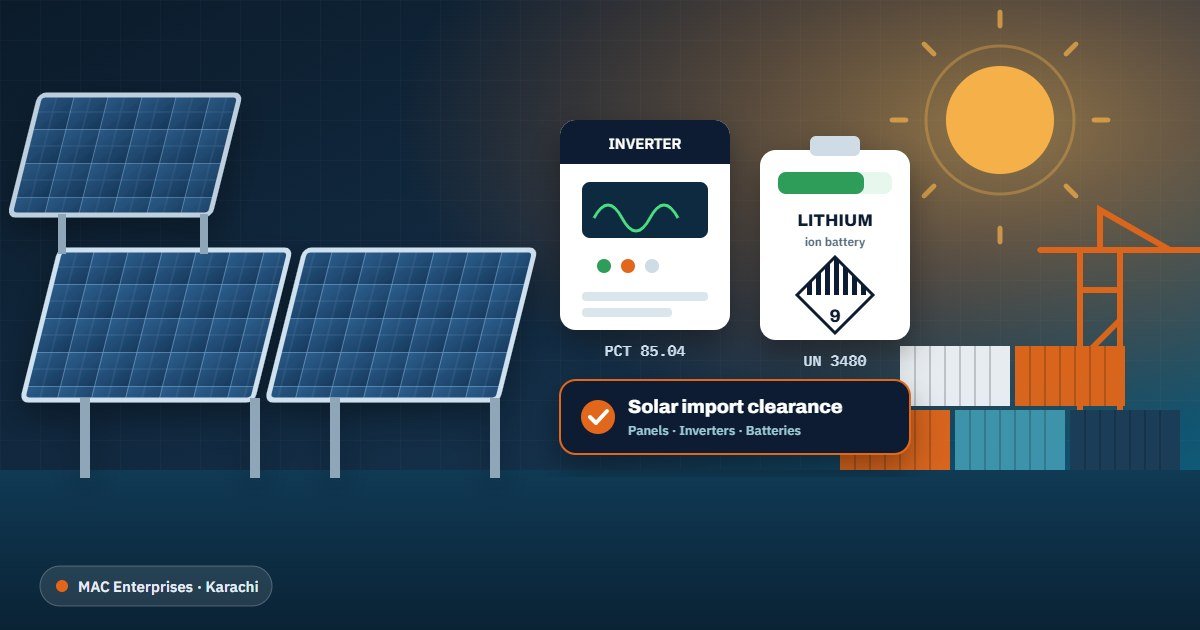
Solar systems are one of the most common commercial imports through Karachi. A single project can include PV modules, inverters, lithium batteries, mounting structures and cables, and each of these is classified and checked differently at customs. This guide explains what solar importers should prepare so the shipment clears at Karachi Port or Port Qasim without delays.
1. Each component has its own PCT heading
Customs classifies every line on the invoice separately. As a general guide:
- Solar PV modules (panels) fall under heading 85.41, which covers photovoltaic cells and modules.
- Inverters are usually classified as static converters under heading 85.04.
- Lithium-ion batteries fall under heading 85.07, electric accumulators.
- Mounting structures, cables and accessories are classified by their material and function, often in different chapters.
Because the duty and tax treatment differs by heading, a mixed solar shipment should never be declared as a single line. List every component separately on the invoice with model, specification and quantity. You can look up headings with the tariff search on our Commodities page.
2. Duty treatment changes: check before you ship
The duty and sales tax treatment of solar equipment in Pakistan has been revised several times through budgets and SROs, and a concession that applies to one item may not apply to another item in the same shipment. Confirm the rates and any concession for each heading at the time of shipping, and again when the Goods Declaration is filed on WeBOC.
3. Valuation: match the price to the specification
Solar modules are closely checked on value. The declared price should be consistent with the panel wattage, cell technology and quantity, and with recent prices for similar modules. Show the wattage per panel, the total wattage and the unit price on the invoice, and keep the supplier's datasheet ready. A price that looks unusually low or unusually high invites questions and can hold the container.
4. Lithium batteries are dangerous goods
Lithium-ion batteries are classified as Class 9 dangerous goods for sea and air transport, for example UN 3480 for batteries shipped on their own. The shipper must provide a Dangerous Goods Declaration, a Safety Data Sheet and the battery test summary, and the packaging and labels must meet the rules. Missing battery paperwork is one of the most common reasons a solar shipment is delayed at origin or on arrival.
5. Documents checklist for solar imports
- Commercial invoice with each component listed separately: model, wattage or capacity, quantity and unit price.
- Packing list with pallet and carton details per component.
- Bill of lading or air waybill.
- Datasheets for panels, inverters and batteries.
- For batteries: Dangerous Goods Declaration, Safety Data Sheet and test summary.
- Certificate of origin where a trade agreement rate is claimed.
6. Plan the port and delivery side
Solar containers are heavy and are often needed on site by a fixed date. Check the free days at the terminal, arrange funds for duties and taxes in advance, and book transport for the release date. Our guide on avoiding demurrage at Karachi Port and Port Qasim covers the full checklist.
How MAC Enterprises helps solar importers
As licensed customs clearing agents in Karachi, we clear solar panels, inverters, batteries and other renewable energy equipment at Karachi Port, Port Qasim and all dry ports, including battery shipments that need dangerous goods handling. Send your invoice and packing list on WhatsApp 0344 5138903 for the PCT headings, a duty estimate and a clearance timeline, or read how to get a duty estimate before shipping.
Step by step: from supplier order to your site
- Before ordering: list every component (panels, inverters, batteries, structures, cables) with its model and specification.
- Check classification and duty: confirm the PCT heading and the duty position for each line. See how to find your PCT code.
- Check approvals: confirm whether any component needs an approval or a test certificate under current import rules.
- Prepare the invoice: one line per component, with wattage or capacity, quantity and unit price.
- Battery paperwork: the shipper arranges the Dangerous Goods Declaration, Safety Data Sheet and test summary before loading.
- Shipping and filing: once the bill of lading is issued, the Goods Declaration is prepared on WeBOC.
- Assessment, examination and payment: customs assesses the value and the heading, and may examine the cargo.
- Release and delivery: transport collects the container within the free days and delivers to your site.
Common mistakes with solar shipments
- One invoice line such as "solar system" instead of separate lines for panels, inverters and batteries.
- No wattage or capacity on the invoice, so the value cannot be checked against the specification.
- Batteries shipped as ordinary cargo, without the dangerous goods declaration.
- A datasheet that describes a different model from the one on the invoice.
- Assuming a concession applies to every item in the shipment without checking each heading.
- No heavy transport arranged for pallets on the day the container is released.
Packing and damage: protect the shipment before it sails
Solar modules are fragile and heavy. Ask the supplier for strong pallets with edge protection, and make sure the number of panels per pallet on the packing list matches the invoice. Take photographs when the container is loaded and again at examination. If a panel is damaged, photographs, the packing list and the insurance documents make it much easier to deal with the shipping line or the insurer.
Frequently asked questions
Can panels, inverters and batteries travel in the same container?
Often yes, but batteries are dangerous goods and must be declared separately. Some shipping lines have their own rules on mixed loads, so ask before booking.
Do I need an approval to import solar panels?
It depends on the product and on the rules in force at the time. We confirm the requirements from your datasheets before the shipment sails.
Which documents do I need?
See the full import documents checklist for Pakistan customs, plus the battery documents listed above.
What will it cost?
Read what makes up customs clearing charges in Karachi, then send your invoice for an estimate.