
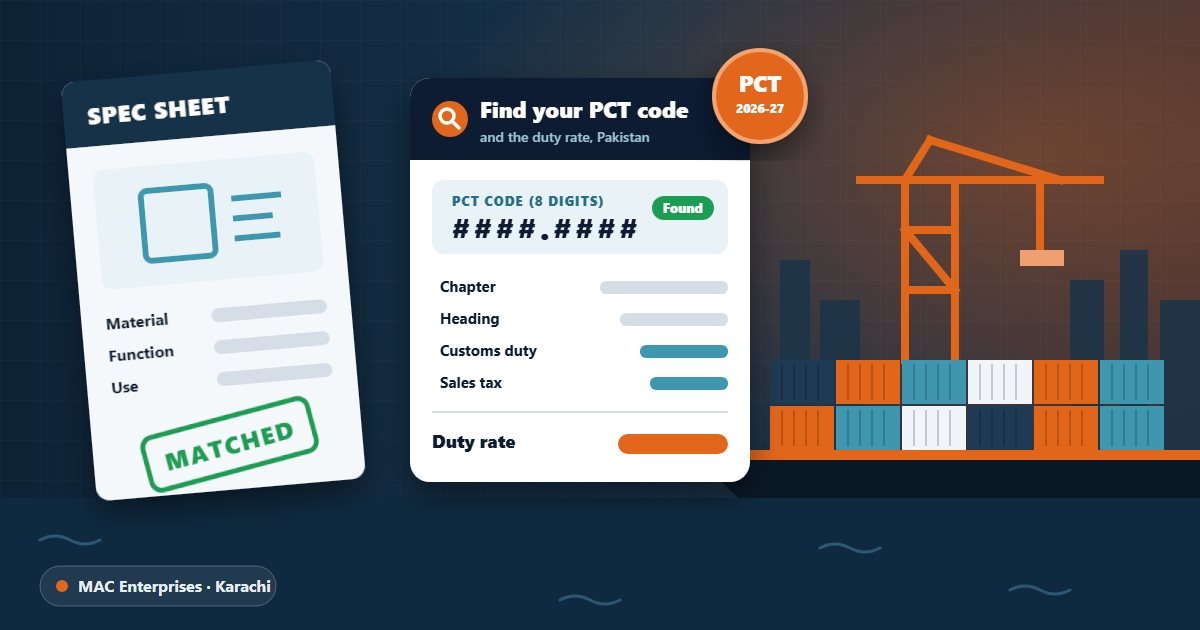
Every import into Pakistan is classified under a code in the Pakistan Customs Tariff (PCT). That code decides the customs duty, affects the other taxes, and can trigger an import approval. Choose the wrong one and the shipment can be reassessed, delayed or penalised. This guide shows how to find the right PCT code for your goods and read the duty rate in the Pakistan Customs Tariff 2026-27, step by step.
What a PCT code is
The PCT is based on the international Harmonized System (HS). A Pakistan PCT code has 8 digits, usually written as ####.####:
- First 2 digits: chapter. There are 97 HS chapters, grouped into sections (for example, Chapter 84 covers machinery and mechanical appliances, Chapter 85 electrical equipment).
- First 4 digits: heading. A group of related products within the chapter.
- First 6 digits: HS subheading. These six digits are the same in every country that uses the HS.
- Last 2 digits: Pakistan's national split. These are set by Pakistan and are where most local differences in duty appear.
Because the first six digits are international, your supplier's HS code is a useful starting point. It is not the final answer: the last two digits, and sometimes the supplier's own choice of heading, need checking against the Pakistan tariff.
Step 1: describe the product properly
Classification starts with what the goods are, not what they are called. Write down:
- What the product is made of (material or composition).
- What it does (function) and how it is used.
- Whether it is complete, incomplete, a part or an accessory.
- Whether it is shipped as a set, in bulk or in retail packing.
The catalogue, specification sheet or MSDS usually answers these questions. A description like "spare parts" or "chemicals" is not enough to classify anything.
Step 2: find the chapter and heading
Search the tariff by keyword and by your supplier's HS code. You can use the PCT tariff search on our Commodities page to look up headings and duty rates for the Pakistan Customs Tariff 2026-27. Read the heading text and the chapter notes: the legal notes at the start of each section and chapter often decide what is included or excluded.
Step 3: apply the classification rules
When a product could fit more than one heading, the General Rules for the Interpretation (GRI) of the Harmonized System decide. In simple terms:
- Classification is decided by the wording of the headings and the section and chapter notes.
- Incomplete or unassembled goods are usually classified as the complete article if they have its essential character.
- The most specific description is preferred over a general one.
- Mixtures and sets are classified by the component that gives them their essential character.
Step 4: narrow down to the 8-digit code
Within the heading, move to the 6-digit subheading and then to Pakistan's 8-digit line. Check the specific conditions in the description, such as size, power, material or use, and make sure your product meets them exactly.
Step 5: read the duty rate and other charges
The tariff gives the customs duty for each code. On top of that, an import can attract additional customs duty, regulatory duty, sales tax and advance income tax, depending on the code and the notifications in force. Some codes also have concessionary rates under SROs, the Fifth Schedule to the Customs Act or trade agreements, which apply only when their conditions are met. Our guide to a duty estimate before shipping shows how these come together.
Step 6: check approvals linked to the code
Some codes are linked to conditions in the Import Policy Order, such as a DRAP, PSQCA or Plant Protection approval. Check this as soon as the code is confirmed. See the full import documents checklist for the approvals that commonly apply.
Common classification mistakes
- Copying the supplier's code without checking the Pakistan 8-digit line.
- Classifying a part under the heading for the complete machine (or the other way round) without checking the notes.
- Choosing a code with a lower rate whose description does not actually fit the goods.
- Using last year's code after the tariff was revised in the budget.
- Different descriptions on the invoice, packing list and bill of lading, which make the code harder to support.
When the code is disputed
If customs disagrees with your classification, the matter can be argued with technical evidence, and difficult cases can be referred for a classification decision. Having the catalogue, specification sheet and a written reason for the chosen code ready before shipping makes this much easier. For more on how rates and codes change each year, read our guide to the Pakistan Customs Tariff 2026-27.
Frequently asked questions
Is the PCT code the same as the HS code?
The first six digits follow the international HS. The last two digits are Pakistan's own split, so an 8-digit PCT code must be checked in the Pakistan tariff.
Does the PCT change every year?
Rates and some codes are revised through the Finance Act, usually with the federal budget, and SROs can change rates during the year. Always use the version in force on the date the Goods Declaration is filed.
Can my clearing agent confirm the code before I ship?
Yes. That is the best time to do it, while the order can still be adjusted.
Get your PCT code confirmed for free
Send the product catalogue or specification sheet and your invoice on WhatsApp 0344 5138903. As licensed customs clearing agents in Karachi, we confirm the PCT code, the duty position and any approval needed before your goods are shipped. See our customs clearance services or contact our Karachi office.
Note: this guide explains the method. Duty rates and codes change through the Finance Act and SROs, so confirm the current position for your goods before shipping.