
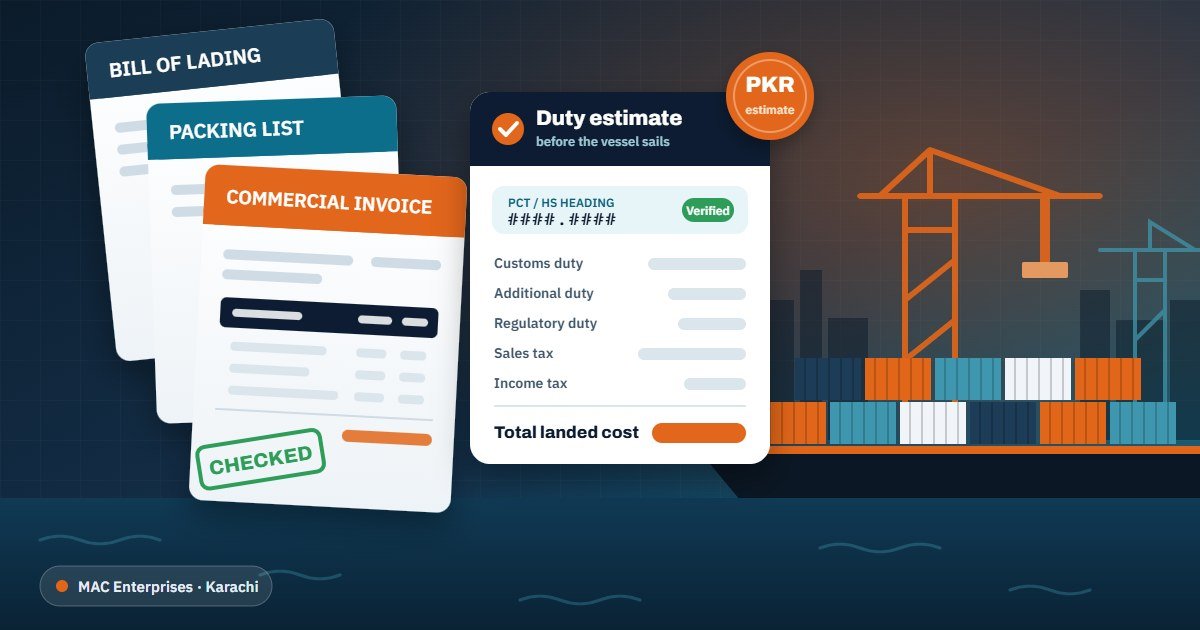
Importers who ask for a customs duty estimate before the vessel sails avoid the most expensive surprise in Pakistan trade: a higher assessment at the port. A customs clearing agent in Karachi can give a realistic figure only when the right documents and the correct PCT heading are in hand. This guide explains the steps we follow at MAC Enterprises before a consignment is shipped.
1. Documents to send for a duty estimate
- Commercial invoice with the full goods description, quantity, unit price and Incoterm (FOB, CFR, CIF or DDP).
- Packing list with weights, number of packages and container details.
- Bill of lading or airway bill, as soon as it is available.
- Catalogue, specification sheet or MSDS when the goods are technical, electrical or chemical.
Sending these on WhatsApp is enough to start. The more complete the description on the invoice, the closer the estimate will be to the final assessment.
2. Choosing the correct PCT heading
Every import is classified under a heading of the Pakistan Customs Tariff (PCT), which follows the Harmonized System. The heading decides the customs duty and also affects other taxes and whether a regulatory NOC is needed. Two products that look alike can fall under different headings, so classification is done from the technical description and use of the goods, not from the product name alone. Where a heading is disputed, a written classification opinion or representation before the Classification Committee can be arranged.
3. How import duty is calculated
The assessed value is the starting point. Depending on the heading and the notifications in force, import charges can include customs duty, additional customs duty, regulatory duty, sales tax and advance income tax. Rates change with the Finance Act and SROs, so an estimate should use the rates that apply when the Goods Declaration (GD) is filed on WeBOC. Always ask your agent for the breakdown, not just one total.
4. Valuation: where importers lose money
Customs can question the declared invoice value. A mismatch between the invoice, packing list and bill of lading is a common trigger, as is an unusually low unit price. If the value is disputed, provisional assessment under Section 81 allows the goods to be released while the valuation matter is argued. Checking the documents against each other before shipping prevents most of these disputes.
5. Regulatory approvals can change the timeline
Some goods need approval before they can be cleared: DRAP for pharmaceutical products and medical devices, PSQCA, ANF, Plant Protection, Animal Quarantine or EPA, depending on the product. Confirming this before the shipment leaves the origin port helps you avoid detention and demurrage at Karachi Port or Port Qasim.
6. Ask for a clearance timeline, not only a price
Terminal free days and shipping line detention run against your cargo from arrival. A useful estimate therefore comes with a timeline that covers examination, any NOC approvals and the terminal gate-out, so you can plan transport and storage in advance.
What you get from MAC Enterprises
Send your commercial invoice, packing list and bill of lading on WhatsApp at 0344 5138903. You get a duty estimate and a clearance timeline back at no charge. We clear at Karachi Port, Port Qasim, KICT, QICT and SAPT and at all dry ports, and we handle commercial consignments for importers and manufacturers. See all customs clearance and freight forwarding services or contact our Karachi office.
How an estimate is built, step by step
- Value: the customs value is established from the invoice and the Incoterm, with freight and insurance added where they are not already included.
- Exchange rate: if the invoice is in a foreign currency, the rate used by customs on the filing date converts it to rupees.
- Heading and customs duty: the duty rate is applied according to the PCT heading.
- Additional and regulatory duty: added where they apply to that heading.
- Sales tax: usually charged on a value that already includes the duties above, so a change in one rate flows into the next.
- Advance income tax: added at the rate that applies to the importer.
This is why one headline figure is not enough. A breakdown shows where each rupee comes from and which part could change.
Why the final assessment can differ from the estimate
- The rates changed between the estimate and the filing date (budget, SRO or notification).
- Customs assessed a different value from the declared one.
- The heading was challenged and a different one was applied.
- The exchange rate on the filing date was different.
- The invoice or packing list was incomplete when the estimate was made.
An estimate is only as good as the information behind it. It is not a promise of the final assessment, which is made by customs.
Estimate or quotation: what is the difference?
A duty estimate covers government charges only. A clearance quotation also covers port, shipping line and agent costs. Ask for both, and keep them separate so that you can compare quotes properly. Our guide to customs clearing charges in Karachi explains the second part.
When to ask for an estimate
The best time is when the supplier sends the proforma invoice, before you pay. At that point the quantity, specification or Incoterm can still be changed if the numbers do not work. The second best time is when the shipment is booked. Asking after the vessel has arrived gives you the figure, but no time to react.
Frequently asked questions
Is the estimate binding?
No. It is based on the documents you provide and on the rates in force when it is prepared. Customs makes the final assessment when the Goods Declaration is filed.
What do you need to start?
The invoice or proforma invoice, the packing list and, for technical goods, the catalogue or specification sheet. See the full import documents checklist.
Can you confirm the PCT code first?
Yes. Read how to find your PCT code and duty rate, then send us the details to confirm.
To start, send your documents on WhatsApp 0344 5138903.